Become a high‑demand Python Full Stack Developer. Master back‑end development with Django and Flask, build interactive front‑ends with React, and work with PostgreSQL, REST APIs, authentication, and cloud deployment. This program prepares you for real‑world web development roles in startups and enterprises.



 18760 Learners
65% hands-on projects & real‑world applications — e‑commerce, social platform, blog CMS, REST APIs.
Curriculum covers Python, Django, Flask, React, PostgreSQL, REST Framework, JWT, Docker, and deployment.
Learn from industry experts who have built scalable Python web apps for fintech, healthcare, and e‑commerce.
Master Python‑powered full‑stack development. Build robust back‑ends with Django and Flask, create dynamic front‑ends with React, and manage data with PostgreSQL. Learn REST APIs, authentication, testing, and deployment. This course bridges the gap between Python coding and modern web frameworks.
✔ 65% hands-on projects • 6 major full‑stack capstones • Build e‑commerce, blog, social app • Official‑style practice exams • 24/7 cloud lab access.
Python (advanced), Django, Flask, Django REST Framework, React (hooks, context), PostgreSQL, SQLAlchemy, JWT authentication, Git, Docker, deployment (Heroku, AWS).
Basic knowledge of Python (variables, functions, loops). No prior web framework experience required.
Build a full‑stack e‑commerce store, a blog CMS with user comments, a social media dashboard, and a task management API with React front‑end.
Mock technical interviews, resume review, GitHub portfolio optimization, and job placement assistance for Python Full Stack Developer, Django Back‑end, and React Front‑end roles.
Tailored Python full‑stack upskilling for teams and enterprises
Choose from Django + React, Flask + Vue, or FastAPI tracks.
Pre‑configured VS Code, PostgreSQL, and API test suites.
Monitor progress and skill gaps with detailed analytics.
Volume discounts for teams of 10+, plus pay-as-you-go options.
Dedicated Python full‑stack mentors to assist your learners anytime.
Single point of contact for seamless training delivery.

Get a custom quote for your organization's development training.
From Python Core to Modern Web Frameworks
Decorators, generators, context managers, OOP principles, and package management (pip, virtualenv).
ORM, templates, class‑based views, forms, authentication, admin interface, and security.
Build flexible APIs with Flask, Flask‑SQLAlchemy, Flask‑JWT, and integrate with front‑end frameworks.
Consume Django/Flask APIs from React, manage state, routing, and authentication flows.
Model relationships, raw SQL, Django ORM, migrations, indexing, and performance tuning.
Deploy to Heroku, AWS EC2, use Docker, Gunicorn, Nginx reverse proxy, and CI/CD pipelines.
Ideal Candidates for Python Full Stack Certification
Designed for developers with basic Python knowledge. This program transforms you into a versatile Python full‑stack developer capable of building and deploying complete web applications. Average salaries for Python Full Stack Developers in India range from ₹6.5 Lakhs to ₹24+ Lakhs per year.
Your Step‑by‑Step Path to Full‑Stack Mastery
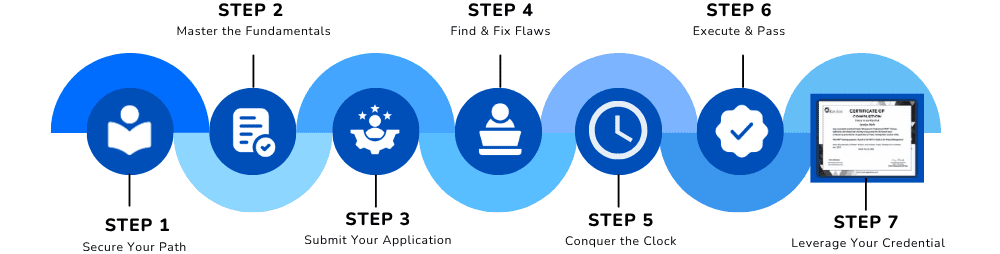
Master Python essentials, then dive into HTTP, MVC, and web server basics.
What You Need Before You Start
Objective: To certify your ability to design, develop, test, and deploy full‑stack web applications using Python frameworks (Django/Flask) and React. Candidates should have:
Variables, data types, functions, loops, conditionals, and basic file I/O.
Familiarity with web basics is helpful but not mandatory.
No prior database or version control experience required — we start from foundational queries.
Comprehensive Python full‑stack modules – from Python to Django, React, and deployment
Data types, conditionals, loops, functions, error handling, and modules.
Classes, inheritance, polymorphism, magic methods, and decorators.
File I/O, generator functions, pip, virtualenv/poetry, and project structure.
Request/response cycle, status codes, REST principles, and API testing with curl.
CRUD, joins, aggregations, indexes, and database design (normalization).
Psycopg2, connection pooling, and raw SQL execution.
Project structure, apps, models, migrations, and Django admin.
Function‑based views, class‑based views, template inheritance, form handling, and validation.
User model, login/logout, permissions, custom middleware, and security best practices.
Serializers, viewsets, routers, authentication (JWT, session), and permissions.
Swagger/DRF‑YASG, Postman collections, unit testing with pytest‑django.
Filtering, pagination, throttling, and versioning.
App creation, blueprints, request/response objects, and error handling.
Database models, relationships, Alembic migrations, and Flask‑Migrate.
Secure endpoints, integrate with React, and build microservices.
Functional components, useState, useEffect, and consuming REST APIs with fetch/axios.
Routing, protected routes, global state management without Redux.
CORS handling, JWT storage (localStorage, httpOnly cookies), and authentication flows.
Implement secure authentication, integrate Google/GitHub OAuth using python‑social‑auth.
Deploy Django/Flask + React apps, use Gunicorn, Nginx, environment variables, and static file serving.
Automate testing, build, and deployment pipelines.
Test Django/Flask views, models, and API endpoints.
Django Debug Toolbar, Flask‑DebugToolbar, cProfile, and logging.
Redis caching, database query optimisation, and CDN integration.
Implement WebSocket consumers, async support, and real‑time notifications.
Persist messages, broadcast events, and update UI in real time.
Django back‑end (product/cart/orders), React front‑end, Stripe/Razorpay integration.
User profiles, posts, likes, comments, real‑time feed using React and DRF.
Coding challenges, system design basics, and job interview practice for Python full‑stack roles.
Lifetime Access
Real Full‑Stack Projects
Mentor Support
Practice Assignments
Certificate Preparation
Join 18,000+ successful developers who launched high‑growth careers with our hands‑on Python full‑stack training. Python powers the world's most popular web applications — be part of the demand.
✅ Limited seats available for the upcoming batch • EMI options available • 100% practical projects
