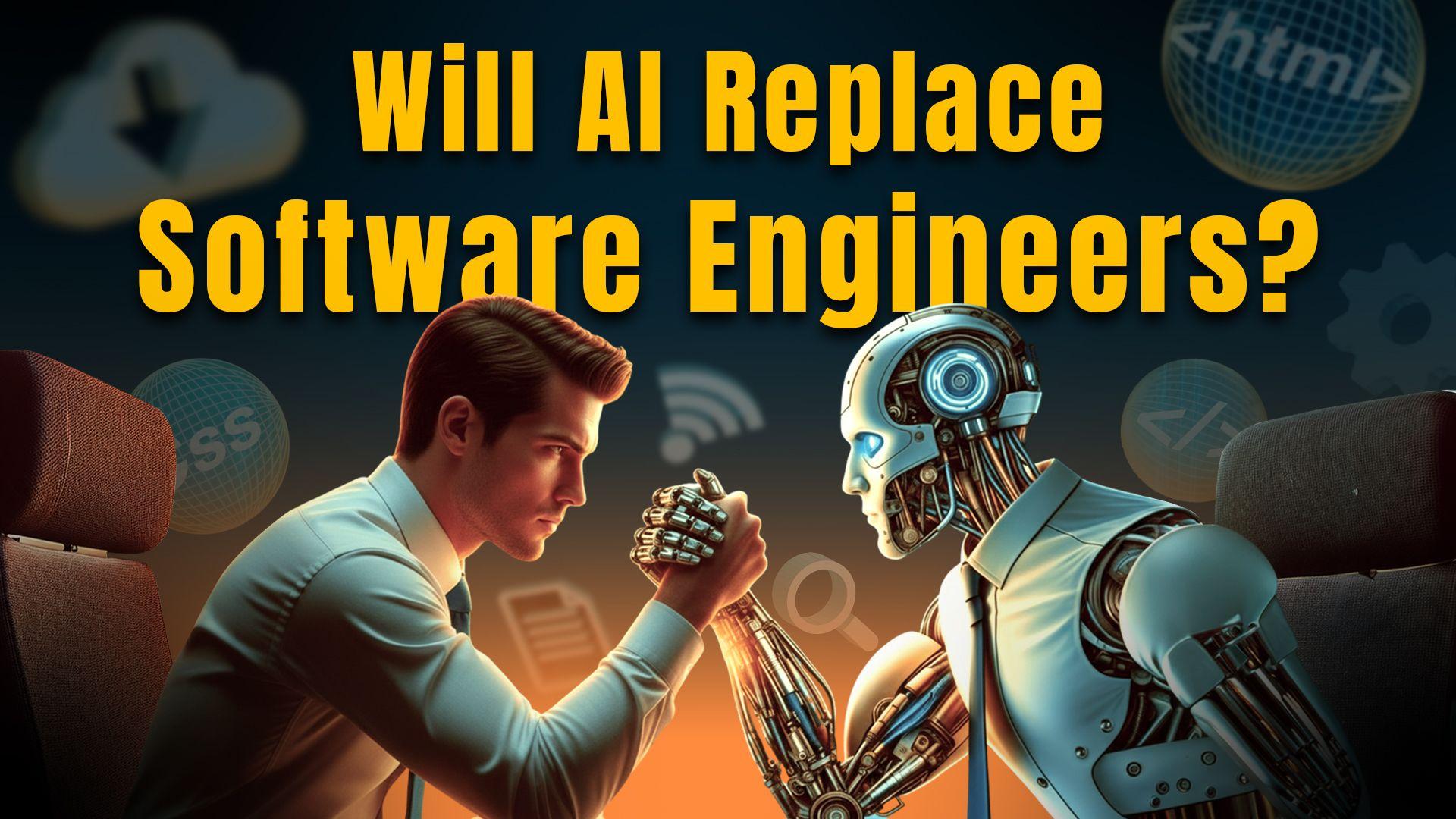
Will AI Replace Software Engineers? The Truth About the Future of Coding
Introduction: The Question Every Developer Is Asking
Artificial Intelligence has transformed software development at an unprecedented pace. Tools like ChatGPT, GitHub Copilot, Claude, and Gemini can now generate code, debug applications, write documentation, and even build complete projects from simple instructions.
Naturally, one question is on everyone's mind:
Will AI replace software engineers?
For students entering the tech industry and professionals already working in software development, the rise of AI can feel both exciting and unsettling.
The short answer is:
No, AI will not replace software engineers. However, software engineers who learn to work with AI will replace those who don't.
The future of software development is not about humans competing against AI. It is about humans and AI working together to build better, smarter, and more innovative solutions.
Let's understand why.
The Difference Between Coding and Software Engineering
Many people use the terms "coder" and "software engineer" interchangeably. But in reality, they are very different.
A Coder
A coder primarily focuses on writing instructions in a programming language. Their work usually involves:
-
Writing functions
-
Fixing syntax errors
-
Implementing predefined features
-
Following detailed specifications
A Software Engineer
A software engineer solves problems and builds systems. Their responsibilities include:
-
Understanding business requirements
-
Designing software architecture
-
Making technical decisions
-
Considering security and scalability
-
Collaborating with stakeholders
-
Managing complex systems
AI can generate code.
But software engineering is much bigger than simply writing code.
Great software is built through human understanding, creativity, communication, and judgment.
What AI Does Exceptionally Well
Artificial Intelligence has become incredibly powerful at handling repetitive and pattern-based tasks.
Code Generation
AI can quickly create:
-
APIs
-
User interfaces
-
Database queries
-
Utility functions
-
Boilerplate code
Debugging Assistance
AI can:
-
Explain errors
-
Suggest fixes
-
Optimize code
-
Recommend improvements
Learning Support
Developers can use AI to:
-
Learn new frameworks
-
Understand algorithms
-
Explore unfamiliar technologies
-
Generate examples and documentation
Faster Prototyping
AI enables developers to create prototypes and MVPs in hours instead of weeks.
These capabilities significantly improve developer productivity.
What AI Still Cannot Replace
Despite its impressive abilities, AI has limitations.
Understanding Business Context
Every business has unique requirements.
A healthcare application, banking platform, or e-commerce system cannot be built purely through code generation.
Successful software requires understanding:
-
Customer needs
-
Industry regulations
-
User behavior
-
Business objectives
AI lacks real-world business understanding.
System Design and Architecture
Designing scalable applications requires making difficult decisions:
-
Monolith vs Microservices
-
SQL vs NoSQL
-
Security trade-offs
-
Performance optimization
-
Cost considerations
These decisions involve experience and judgment.
AI can suggest options, but humans make the final decisions.
Creativity and Innovation
The world's most successful software products were created because someone identified a problem and imagined a better solution.
AI can generate ideas based on existing data.
Humans create entirely new possibilities.
Innovation remains deeply human.
Communication and Collaboration
Software development is a team activity.
Engineers constantly:
-
Discuss requirements
-
Gather feedback
-
Manage stakeholders
-
Lead teams
-
Resolve conflicts
-
Understand customer pain points
These skills cannot be automated.
Critical Thinking
AI can generate code that appears correct but may contain:
-
Security vulnerabilities
-
Performance issues
-
Hidden bugs
-
Scalability limitations
Software engineers must evaluate AI-generated solutions critically.
Blindly accepting AI outputs is dangerous.
Why AI Is Changing Software Engineering
The role of developers is evolving.
In the past, engineers spent most of their time writing code.
Today, they increasingly spend time:
-
Designing systems
-
Reviewing AI-generated code
-
Making technical decisions
-
Managing software complexity
-
Solving business problems
The future engineer is becoming:
Part Developer + Part Architect + Part Product Thinker + Part AI Collaborator
This transformation makes engineering more strategic and impactful.
Is AI Taking Away Software Jobs?
This question creates significant fear among students and professionals.
The reality is more balanced.
Some routine tasks are being automated.
However, technology has always created new opportunities.
When cloud computing emerged, new careers appeared:
-
Cloud Engineers
-
DevOps Engineers
-
Site Reliability Engineers
Similarly, AI is creating entirely new roles:
-
AI Engineers
-
Generative AI Developers
-
Prompt Engineers
-
AI Solution Architects
-
Responsible AI Specialists
-
AI Product Managers
-
AI Integration Engineers
As AI adoption increases, demand for professionals who understand both software engineering and AI will continue growing.
Why Software Engineers Will Remain Essential
Someone Must Define the Problem
AI can build solutions.
Humans decide:
-
What to build
-
Why to build it
-
For whom to build it
Defining problems is often harder than solving them.
Someone Must Validate the Output
AI occasionally produces incorrect information.
Someone must verify:
-
Accuracy
-
Security
-
Reliability
-
Performance
Software engineers provide this critical oversight.
Someone Must Build Responsible Systems
AI systems require:
-
Security measures
-
Ethical guidelines
-
Governance frameworks
-
Monitoring mechanisms
-
Human oversight
These responsibilities cannot be delegated entirely to machines.
Skills Every Developer Should Learn in the AI Era
System Design
Understand how software behaves in production environments.
Learn:
-
Scalability
-
Distributed systems
-
Databases
-
Caching
-
APIs
Problem Solving
Employers hire engineers to solve problems, not merely write syntax.
Develop:
-
Analytical thinking
-
Logical reasoning
-
Decision-making skills
AI Integration
Learn:
-
Large Language Models
-
Prompt Engineering
-
AI APIs
-
AI Workflows
-
Retrieval-Augmented Generation (RAG)
AI integration is rapidly becoming an essential developer skill.
Communication Skills
Great engineers can:
-
Explain technical concepts
-
Collaborate effectively
-
Understand customer needs
-
Lead projects
Communication is becoming one of the most valuable skills in technology.
Continuous Learning
Technology changes rapidly.
The best engineers continuously:
-
Learn new tools
-
Build projects
-
Experiment with technologies
-
Adapt to change
Lifelong learning is the biggest competitive advantage.
What Students Should Focus On
If you're beginning your software engineering journey, don't fear AI.
Instead:
Learn programming fundamentals
Master problem-solving skills
Understand data structures and algorithms
Learn system design concepts
Build real projects
Explore AI tools and frameworks
Use AI as a learning partner
Remember:
AI is not your competition. Ignoring AI is.
The Future of Software Engineering
Software engineering is not disappearing.
It is evolving.
Tomorrow's engineers will spend less time writing repetitive code and more time:
-
Designing intelligent systems
-
Building AI-powered applications
-
Solving complex problems
-
Making strategic decisions
-
Creating innovative products
The demand for human creativity, judgment, and leadership will continue to grow.
The engineer of the future will not simply be a coder.
They will be a problem solver, architect, innovator, and AI collaborator.
Final Thoughts
Will AI replace software engineers?
No.
AI will automate repetitive coding tasks and dramatically improve productivity.
But software engineering is much more than writing code.
It requires:
-
Critical thinking
-
System design
-
Business understanding
-
Creativity
-
Communication
-
Leadership
The future belongs to engineers who learn to leverage AI rather than fear it.
The question is not:
"Will AI replace software engineers?"
The real question is:
"Are you preparing yourself to become the kind of engineer that AI cannot replace?"
Because the future of coding is not Human vs AI.
It is:
Human + AI = Extraordinary Innovation
Ready to Build Your Career in the AI Era?
At Coding Now – Gurukul of AI, we help students become industry-ready engineers by combining:
Artificial Intelligence
Generative AI
Full Stack Development
Prompt Engineering
Real-World Projects
Industry Mentorship
System Design and Architecture
🌐 Website: https://codingnow.in
📧 Email: info@codingnow.in
📞 Phone: +91 9667708830
Learn. Build. Innovate. Lead the Future with AI.
#ArtificialIntelligence #SoftwareEngineering #AIEngineer #Coding #Programming #FutureOfWork #GenerativeAI #PromptEngineering #CodingNow #Technology
