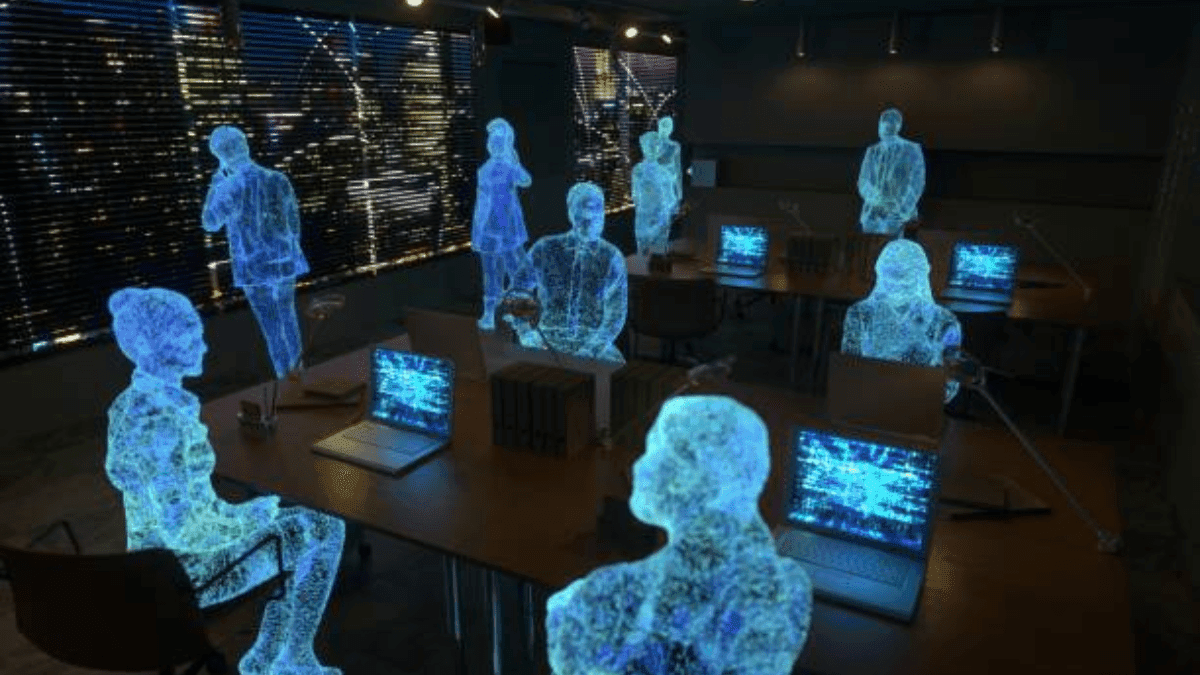
The Big Question
Let us ask you something directly.
You are a business leader, an HR professional, or a founder. You read headlines about AI agents entering the workforce. TCS says it will have as many AI agents as human employees . EY is planning 100,000 digital workers . McKinsey has already added 25,000 "digital employees" to complement its 40,000-person workforce .
You think to yourself: "Is this real? What does an AI employee actually do? Will they replace my people? How do I prepare?"
We hear these questions every week from business leaders who visit our center near Pitampura Metro.
Here is the honest answer based on the latest data and expert analysis: AI employees are not replacing humans wholesale. They are augmenting them, automating routine tasks, and freeing humans to focus on higher-value work. The businesses seeing the greatest returns are using AI to amplify human expertise, not replace it .
But the workforce structure is changing. The traditional hiring pyramid is reshaping into a diamond, requiring fewer people at the bottom and more experienced professionals who can govern, integrate, and orchestrate AI systems . The businesses that adapt will thrive. Those that do not will fall behind.
Let us break down everything you need to know.
Step 3: What Are AI Employees?
Before we dive into the implications, let us clearly define what an AI employee is.
The Simple Definition:
An AI employee is an autonomous AI agent that performs specific tasks, coordinates across multiple systems, and collaborates with human team members as part of the workforce . Unlike chatbots that respond to prompts, AI agents take action—they book meetings, process refunds, analyze data, and escalate issues—without human intervention .
Key Characteristics of AI Employees:
| Characteristic | What It Means |
|---|---|
| Autonomy | Can execute multi-step workflows independently |
| Tool Use | Integrates with existing enterprise systems |
| Collaboration | Works alongside humans as a "teammate" |
| Governance | Requires oversight, permissions, and guardrails |
| Continuous Learning | Improves over time through feedback and data |
The Distinction from Copilots:
The term "AI employee" implies role-based execution rather than task-based assistance. A copilot suggests. A digital employee does .
Step 4: The Numbers – How Big Is This Shift?
Let us look at the data that quantifies this transformation.
Real-World Deployments:
| Organization | AI Employee Commitment | Source |
|---|---|---|
| TCS | Equal number of AI agents and human employees within 3 years | |
| EY | 100,000 AI agents by 2028 | |
| McKinsey | 25,000 "digital employees" already deployed | |
| Goldman Sachs | Deployed "Devin" autonomous software engineer | |
| Moderna | 3,000 custom GPT models; IT and HR departments merged |
Adoption Statistics:
| Metric | Value |
|---|---|
| Organizations planning to integrate AI agents in 2026 | 70% |
| HR leaders who believe AI agents will transform workplace norms | 75% |
| AI agent software spending (2026) | $206.5 billion |
| AI agent software spending (2027) | $376.3 billion |
Productivity Gains:
Early applications of agentic AI in customer service, HR, and sales have led to productivity gains of 30-50% . At Wipro, an AI agent handling 50 HR tasks reduced average response time from 48 hours to 5 seconds .
Step 5: The Real Impact – Replacement or Redesign?
The public debate often frames AI as either a job destroyer or a job creator. The reality is more nuanced.
The Layoff Narrative Has Limits
PwC Global Chairman Mohamed Kande pushed back on what he described as the "simplest version of the AI layoff story." In a CNBC interview, he said businesses adopting AI "at scale" are not simply cutting workers. The fastest-moving firms are increasing headcount because AI lets them expand what employees can do .
PwC's Data Supports This View:
The firm's 2026 AI Jobs Barometer found that companies most exposed to AI have grown headcount faster than the least-exposed firms. AI gives workers "superpowers," making judgment, collaboration, emotional intelligence, and adaptability more valuable .
However, The Pressure Is Real:
Challenger data shows U.S. employers announced 97,006 job cuts in May, with AI being the top reason for a third straight month . Meta cut 8,000 jobs. Microsoft prepared thousands of cuts after an $80 billion AI capex plan .
The Two-Track Labor Market:
| Track | Description | Job Growth | Salary Growth |
|---|---|---|---|
| Professionalised Roles | AI automates routine tasks, emphasizing human judgment | 2x faster | 42% faster |
| Democratised Roles | AI reduces the skill barrier for non-experts | Slower | Lower |
Step 6: The Shifting Workforce Structure
India's IT services industry offers a clear lens into how workforce structures are changing.
From Pyramid to Diamond:
For three decades, the industry relied on a pyramid model: thousands of junior engineers executing routine tasks. That model is being reshaped into a diamond .
| Old Model (Pyramid) | New Model (Diamond) |
|---|---|
| Many entry-level workers | Fewer entry-level workers |
| Limited middle layer | Expanded middle layer of AI-augmented professionals |
| Senior layer on top | AI governance and orchestration roles |
What This Means for Hiring:
| Action | Reason |
|---|---|
| Fresher hiring is slowing | Automation is taking over routine coding, testing, and support |
| Experienced hiring is growing | Demand for AI engineers, data specialists, agent architects, and AI governance professionals |
| Mid-level managers becoming "player-coaches" | Managing both human teams and AI agents |
TCS has started its FY27 fresher hiring with a target of 25,000—among the lowest since FY20. Other players such as HCLTech and Wipro have not yet disclosed their campus hiring numbers . However, TCS Chairman Chandrasekaran maintained that the impact on hiring will be restricted to the transition phase: "Once the transition happens, the AI world will produce so much more opportunities; there will be new talent that will be required" .
Declining Roles:
| Role | Why Demand Is Falling |
|---|---|
| Routine coding and bug fixing | AI agents automate this work |
| Manual testing | Automated testing tools |
| Basic application support | AI handles routine queries |
| Simple documentation | AI can generate and maintain documentation |
Rising Roles:
| Role | Why Demand Is Growing |
|---|---|
| AI application developers | Building AI-powered systems |
| Agentic AI implementers | Deploying and managing AI agents |
| Cloud architects | Running AI workloads at scale |
| Cybersecurity experts | Securing AI systems |
| AI governance professionals | Ensuring compliance and ethics |
Step 7: The Indian Leadership in AI Adoption
India is at the forefront of this shift. The Boston Consulting Group's (BCG) latest AI at Work 2026 report found that India leads the world in workplace AI adoption .
Key Findings:
| Metric | India | Global Average |
|---|---|---|
| Frontline employees saving at least one full workday per week | 70% | Lower |
| Employees reporting increased job satisfaction | 88% | 57% |
| Managers and leaders using AI regularly | 97% | Lower |
| Employees believing AI agents could perform half their job in 3 years | 86% | 52% |
The "Joy Paradox":
While AI improves productivity and job satisfaction, it also increases cognitive demands. About 40% of respondents report higher mental workload, indicating what the report describes as a "joy paradox"—work becomes both more efficient and more demanding .
Strategic Clarity Is Key:
The study found that strategic clarity, rather than tools alone, is the primary factor in translating AI adoption into measurable business outcomes. Organizations redesigning workflows end-to-end are significantly more likely to report both improved business performance and higher employee satisfaction .
Step 8: Santander's AI Workforce Transformation
Banco Santander provides a concrete example of AI at scale in a traditional industry.
The Scale:
The bank is equipping all 185,000 employees with AI tools, including Microsoft's Copilot, OpenAI's ChatGPT, Anthropic's Claude, and Google's Gemini .
The Impact So Far:
| Metric | Number |
|---|---|
| Employees using AI (pre-expansion) | 40,000 |
| Percentage of code developed by AI | 40% |
| AI models processing anti-money laundering alerts per year | 100,000 |
| Process automation agents in production | 280+ |
| Business value generated in Q1 2026 | €35 million |
The Strategy:
"For many employees, this means using AI in everyday productivity tools to prepare analysis, find information faster, summarize documents, improve customer conversations or simplify internal processes," said Ricardo Martín Manjón, chief data and AI officer at Santander. "We are not starting from theory: AI is already improving processes, supporting our teams and opening new opportunities across the bank" .
Step 9: What This Means for HR and Workforce Planning
The rise of AI employees requires a fundamental rethinking of HR practices.
Three Emerging Skills for the Hybrid Workforce:
According to a recent survey of HR leaders, three skills are emerging as top priorities during recruitment :
-
Relationship building—forging constructive partnerships and account management
-
Collaboration
-
Adaptability
The Role of Managers:
| Traditional Role | New Role |
|---|---|
| Task supervision | Orchestrating blended systems |
| Managing people | Supervising AI agents + motivating humans |
| Process enforcement | Designing AI-human workflows |
Ateet Jayaswal, chief culture and employee experience officer at Wipro, summarizes the shift: "The nature of your job changes from being the hero who comes in to solve the problem to designing the hero who can solve the problem" .
Onboarding Digital Employees:
Freshworks' guide to onboarding AI employees emphasizes several key questions organizations must answer :
| Question | Why It Matters |
|---|---|
| Do you even need an agent for this? | Agents should simplify work, not add complexity |
| What rules do they need to follow? | Strong governance dictates how agents are built and operated |
| What are you hiring them to do? | Strict limits on data access and autonomy |
| How do you know they're doing a good job? | Clear KPIs and performance metrics |
| Who's the boss of that bot? | Accountability and oversight structures |
The Rule for Human-AI Interaction:
"There can be no ambiguity with regard to what the AI does, and the way it interacts with humans can be defined in one simple rule: The AI proposes and the humans decide," said Tiberiu Trandaburu, CEO of Uptalen .
Step 10: The Economics of AI Employees
The Cost Reality:
Phil Fersht, founder and CEO of HfS Research, notes that the economics of agentic delivery can quickly become challenging if organizations simply throw frontier models at every task. The smarter providers are moving toward model orchestration strategies where smaller, cheaper models handle routine work and expensive frontier models are reserved for complex reasoning and decision-making .
Three Cost Buckets for IT Services:
| Bucket | Description |
|---|---|
| Internal service delivery | Using AI to build and deploy software for clients |
| Internal operations | AI for internal processes |
| Proprietary IP | Investment in AI solutions being taken to market |
The Bottom Line:
In many enterprise engagements, compute costs are borne by the client. Enterprises want their code built in their own environments using their own model instances for security and governance reasons . Service providers are actively exploring open-source model alternatives to manage escalating costs.
TCS's AI Revenue Growth:
TCS's annualized AI revenue run-rate increased from $1.5 billion in Q2 FY26 to $2.3 billion in Q4 FY26—a compound quarterly growth rate of about 22%. Chandrasekaran expects AI-driven revenue to grow 100% year-on-year .
Step 11: Opportunities for Professionals
New Human Roles Emerging:
| Role | Description |
|---|---|
| AI Trainers | Use datasets and examples to impart subject knowledge |
| AI Alignment Specialists | Define ethical constraints to ensure agents behave fairly |
| AI Orchestrators | Lead hybrid human-AI teams, deciding which tasks are best for each |
How to Thrive:
Santosh Janardhan, vice-president of infrastructure at Meta, said: "Fundamentally, AI is not going to take away your job. Somebody who knows how to use AI will take your job" .
Professionals Should Focus On:
| Skill | Why It Matters |
|---|---|
| AI literacy | Understanding what AI can and cannot do |
| Problem framing | Clearly articulating what modular steps are needed |
| Critical thinking | Evaluating and questioning AI outputs |
| Adaptability | Learning new tools and workflows continuously |
Step 12: How Coding Now Prepares You for the AI Workforce
At Coding Now – Gurukul of AI, we are preparing students for exactly this hybrid workforce.
Our Relevant Programs:
| Program | Duration | Skills Covered |
|---|---|---|
| AI Engineering Diploma | 6 months | Python, ML, LLMs, RAG, LangChain, Multi-Agent Systems, Deployment |
| Data Science | 4 months | Python, Pandas, NumPy, Statistics, ML, SQL |
| AI-Integrated Full Stack | 6 months | Python, Django/Flask, AI Integration |
What We Teach That Matters for the Hybrid Workforce:
| Skill Area | Specific Skills |
|---|---|
| AI Literacy | Understanding LLMs, AI capabilities, and limitations |
| Agentic AI | LangChain, agents, tools, memory, multi-agent systems |
| RAG and Vector Databases | Building document Q&A systems |
| Integration | Connecting AI systems to existing workflows |
| Deployment | Getting AI systems to production |
Placement Support:
| Metric | Number |
|---|---|
| Students placed | 3,200+ |
| Hiring partners | 3,500+ |
| Average salary | ₹8-18 LPA |
| Highest package | ₹34 LPA |
Our Location: 2nd Floor, Kapil Vihar, opposite Metro Pillar No.354, Pitampura, New Delhi – 110034
Limited Offer: 50% OFF on select courses. Call +91 9667708830.
Step 13: Pro Tips for Businesses Adopting AI Employees
Tip 1: Redesign Workflows Before Deploying Agents
Companies that don't have their workflows in order first will have agents that automate the wrong things. Process re-engineering must come first .
Tip 2: Establish Governance First
Strong governance dictates how agents are built, how they operate, and who audits them. Define accountability before deployment .
Tip 3: Start with a Small Group of First Adopters
Drop AI on the team via a corporate email, and you will meet resistance. Start with champions who can provide feedback .
Tip 4: Keep Humans in the Loop
The rule should be: "The AI proposes and the humans decide" .
Tip 5: Invest in Workforce Training
Employees need AI literacy. Leaders need to understand how to manage blended teams. Reskilling is essential .
Step 14: Frequently Asked Questions
Q1: Will AI employees replace human workers?
Not wholesale. Companies using AI to amplify human expertise are growing headcount faster than those that do not . However, entry-level roles are transforming, requiring higher-level skills earlier in careers.
Q2: How many AI agents will companies deploy?
TCS expects equal numbers of agents and human employees within 3 years . EY plans 100,000 agents by 2028 . Spending on AI agents is set to reach $206.5 billion in 2026 .
Q3: What is the "pyramid to diamond" shift?
The traditional hiring pyramid with many entry-level workers is reshaping into a diamond with fewer entry-level roles and an expanded middle layer of professionals who can govern AI systems .
Q4: Which roles are declining?
Routine coding, bug fixing, manual testing, basic application support, and simple documentation .
Q5: Which roles are growing?
AI application development, agentic AI implementation, cloud architecture, cybersecurity, data engineering, and AI governance .
Q6: What skills do employees need in a hybrid workforce?
AI literacy, problem framing, critical thinking, adaptability, and relationship building .
Q7: Does Coding Now teach the skills needed for the hybrid workforce?
Yes. Our programs cover AI literacy, agentic AI, RAG, integration, and deployment.
Q8: How do I enroll?
Call +91 9667708830 or visit our center at 2nd Floor, Kapil Vihar (Opp. Metro Pillar No.354), Pitampura, New Delhi – 110034.
Step 15: Final Tagline
"AI Employees Are Joining the Workforce. Are You Ready to Work Alongside Them?"
Hashtags:
#AIEmployees #DigitalEmployees #AIAgents #FutureOfWork #HybridWorkforce #AgenticAI #CodingNow #GurukulOfAI
Step 16: A Note on the AI Workforce Revolution
The rise of AI employees is not a distant future. It is happening now. TCS, EY, Santander, McKinsey, Goldman Sachs, and Moderna are all deploying AI agents at scale .
The workforce structure is changing. The skills that matter are changing. The relationship between experience and expertise is changing .
But one thing remains constant: human judgment, creativity, and collaboration are more valuable than ever. AI agents handle routine work. Humans focus on higher-value work .
The businesses that adapt to this hybrid workforce will thrive. Those that do not will fall behind.
At Coding Now, we are committed to helping you build the skills that matter in this new world. Come visit us. Take a free demo class. See what is possible.
Your hybrid workforce journey starts now.
Contact Us
Phone: +91 9667708830
Email: info@codingnow.in
Website: https://codingnow.in/
Address:
2nd Floor, Kapil Vihar (Opp. Metro Pillar No.354)
Pitampura, New Delhi – 110034
Backlink to main website: Explore AI Engineering Diploma and other courses at Coding Now – Gurukul of AI
