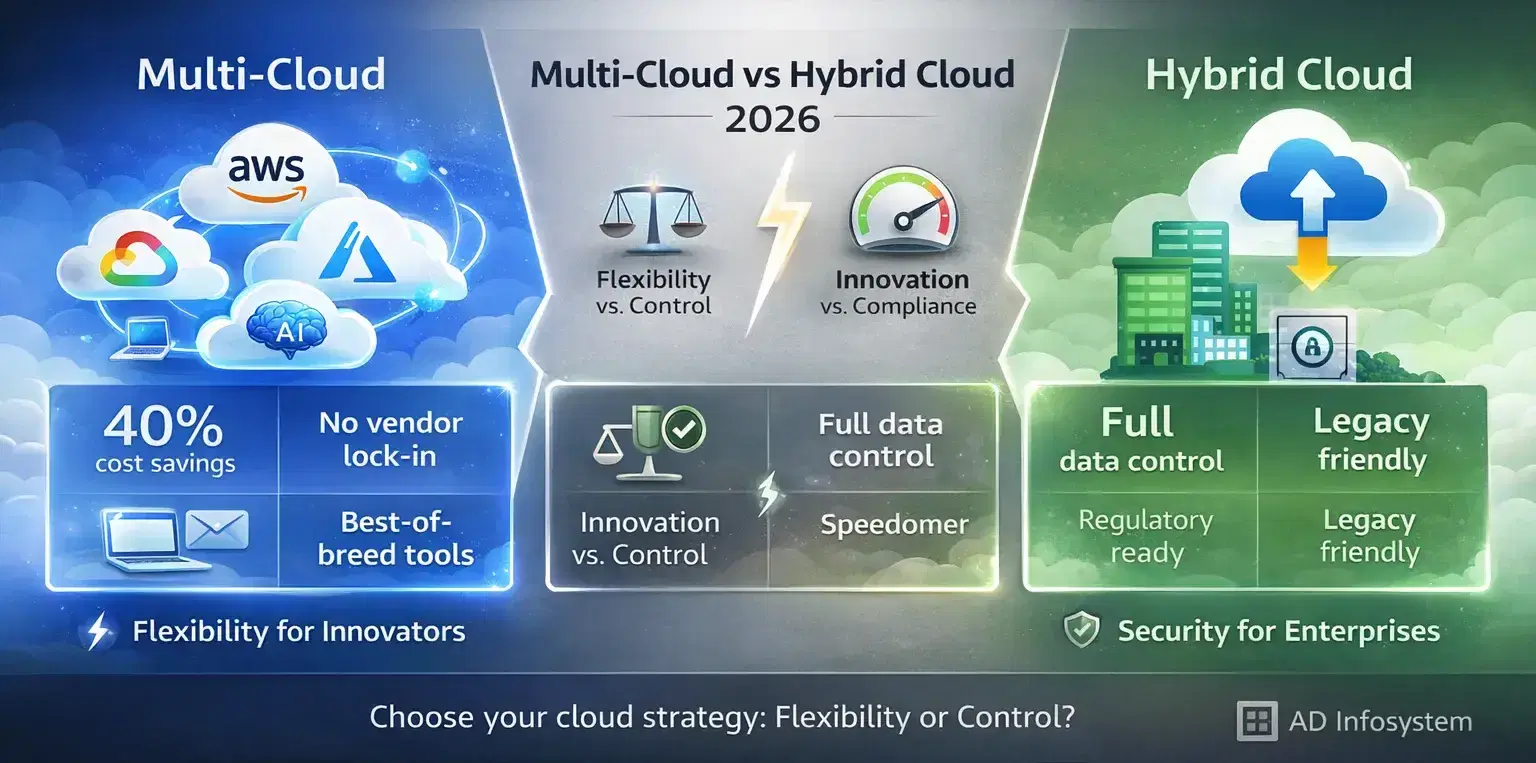
Hybrid & Multi-Cloud Strategies: The New Normal in 2026
By 2026, hybrid and multi-cloud architectures have evolved from a transitional phase to the dominant, intentional operating model for enterprises . The data confirms this shift: according to the Flexera 2026 State of the Cloud Report, 88% of organizations now operate a multi-cloud strategy, while 73% combine public and private clouds in hybrid setups This represents a significant increase from 2025, when 87% of respondents used a multi-cloud strategy . The question is no longer if organizations should adopt these models, but how to manage them effectively .
What's Driving the Shift?
Three key forces are pushing hybrid and multi-cloud from a "nice-to-have" to a critical business requirement:
The AI Imperative: AI workloads are now the primary driver of cloud growth, outpacing traditional migration programs . AI-native clouds are emerging, specifically optimized for high-performance computing and large-scale machine learning . Organizations need the flexibility to place workloads where they perform best and cost the least—a core benefit of multi-cloud .
The Resilience Mandate: High-profile outages at major providers have shown the dangers of relying on a single vendor . A multi-cloud approach insulates organizations from single points of failure, distributing risk across providers . Modern resilience now extends beyond simple recovery to include strategic agility in response to shifting commercial and regulatory conditions .
Data Sovereignty and Compliance: Governments and businesses are building guardrails around data and AI . Data sovereignty concerns are driving more private cloud use, with Forrester expecting private cloud revenue growth to double year-over-year from approximately 13% to nearly 25% in 2026 . Industry clouds—sector-specific solutions for healthcare, finance, and manufacturing—are also gaining traction . In India, leaders from NSE and Ashok Leyland emphasized compliance and data control as defining themes in cloud strategy .
Challenges of Multi-Cloud Complexity
While the benefits are clear, the operational reality is demanding:
Management Complexity: IT teams juggle multiple management consoles, fragmented visibility, and inconsistent tools across providers . This leads to "tool sprawl" and siloed operations .
Skills Gap: Managing multiple platforms requires diverse expertise that many organizations lack internally . Upskilling is becoming a strategic priority, as 89% of organizations say hiring is more expensive than upskilling for IT roles .
Cost Control: Cloud spend can spiral without disciplined governance . CIOs warn that unmanaged cloud consumption is like an uncontrollable credit card . FinOps practices—tracking, tagging, and optimizing costs across providers—are now essential .
Integration and Egress Fees: Moving data between clouds is slow and expensive . These egress fees can erase savings from choosing a cheaper provider .
How Organizations Are Succeeding
Successful hybrid and multi-cloud strategies share common patterns:
Standardized Operations: Leading organizations are creating a "unified substrate" across all environments—using software-defined networking, consistent identity and access management (IAM), and common metrics . Infrastructure-as-code tools like Terraform and container orchestration with Kubernetes enable consistent provisioning and deployment across clouds .
Intelligent Workload Placement: Rather than a "lowest common denominator" approach, successful teams place each workload on the cloud that fits it best—analytics on one, AI inference on another, customer-facing services on a third—while minimizing cross-cloud data movement .
Sovereign-by-Design Architecture: In regions with strict data residency requirements, organizations are adopting private cloud or sovereign cloud options that keep data within jurisdictional boundaries while still leveraging public clouds for innovation . IBM's Sovereign Core and Tata Communications' Vayu platform exemplify this trend in India .
Hybrid Serverless for AI: Serverless architectures are becoming the default for AI agents, with 80% adopting hybrid models—using Function-as-a-Service for stateless workloads and serverless containers for long-running, stateful processes .
Looking Ahead
By the end of 2026, cloud computing will look less like a single destination and more like a distributed ecosystem spanning multiple providers, regions, and technologies . The organizations that succeed will be those that balance innovation with control: harnessing AI to innovate, distributing workloads to safeguard resilience, and enforcing financial discipline to sustain value . As one CIO put it, the strategy is no longer about moving faster, but moving smarter .
------------------------------------------------------------------------------------------------------------------------------------
Contact Us
Phone: +91 9667708830
Email: info@codingnow.in
Website: https://codingnow.in/
Address:
2nd Floor, Kapil Vihar (Opp. Metro Pillar No.354)
Pitampura, New Delhi – 110034
Backlink to main website: Explore AI Engineering Diploma and other courses at Coding Now – Gurukul of AI
