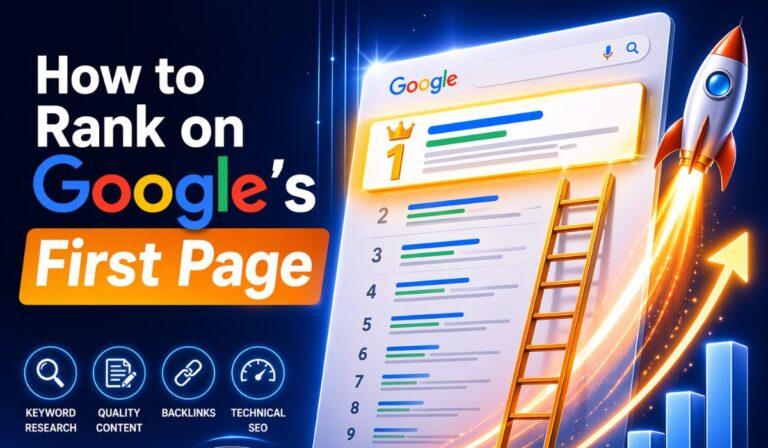
How to Rank on Google's First Page in 30 Days: A Realistic Guide
Ranking on Google's first page is the holy grail of SEO. The data is stark: the top three results capture 54.4% of all clicks, and only 0.63% of searchers ever make it to page two . If your site is buried, you're essentially invisible.
But here's the truth: ranking within 30 days is absolutely possible—but only if you're strategic about it . You won't outrank The New York Times for "news," but you absolutely can compete for the right keywords and topics .
This is a realistic, week-by-week guide built from proven strategies. No hype, no shortcuts—just actionable steps you can take today.
The Reality Check: What Actually Works in 30 Days
Before diving into tactics, understand what's realistic:
-
Target low-competition, long-tail keywords. Highly competitive, short-tail keywords (like "SEO" or "digital marketing") are nearly impossible to rank for quickly. Instead, target specific phrases like "how to rank on Google first page in 30 days" . These have clear intent and less competition.
-
Focus on "low-hanging fruit." Identify keywords with low difficulty scores (ideally under 29%) and decent search volume (100–500 monthly searches) .
-
Fix what already exists. Updating and improving your existing top-performing pages often yields faster results than creating brand-new content from scratch .
The 30-Day Action Plan
🔍 Week 1: Research, Audit & Technical Setup (Days 1–7)
The first week is about laying a solid foundation. If your site is broken, nothing else matters.
| Day | Task | Quick Tip |
|---|---|---|
| 1–2 | Run a complete website audit using Google Search Console, PageSpeed Insights, and Screaming Frog . | Identify slow pages, broken links, crawl errors, and thin content. |
| 3–4 | Conduct keyword research with tools like Google Keyword Planner or SEMrush . | Focus on long-tail keywords with 100–500 monthly searches and buyer intent. |
| 5–6 | Fix technical SEO: submit your sitemap to Search Console, ensure HTTPS/SSL, and check mobile-friendliness . | Google uses mobile-first indexing—if your site isn't mobile-friendly, you're fighting an uphill battle . |
| 7 | Optimize meta titles and descriptions for your key pages. | Keep titles under 60 characters and start with your primary keyword . |
Week 2: On-Page SEO & Content Optimization (Days 8–14)
This is where you signal to Google exactly what your pages are about.
-
Optimize every page's title tags, meta descriptions, URLs, and H1 headers with your primary keyword .
-
Place your primary keyword within the first 100 words of your content .
-
Use related keywords (LSI keywords) naturally throughout the text to build topical relevance .
-
Improve the hero section of your homepage. Clearly answer: "What do you do and who is it for?" in plain language .
-
Add an FAQ section to key pages with 4–6 questions in natural language. This helps you appear in "People Also Ask" boxes .
Week 3: Content Creation & Internal Linking (Days 15–21)
Fresh, high-quality content is the engine of SEO. But don't just write for the sake of writing.
-
Publish 3–5 blog posts targeting your researched long-tail keywords .
-
Update and refresh your 3 highest-traffic articles—add new examples, updated statistics, and improve readability .
-
Create 2 bottom-of-funnel pages like "Why [Your Product] vs [Competitor]" or "[Product Category] for [ICP]" .
-
Add internal links from high-authority pages to new content. This helps Google discover and index new pages faster .
-
Write 2,000+ word, comprehensive articles where possible—long-form content consistently outranks shorter pieces .
Week 4: Authority, Backlinks & Promotion (Days 22–30)
Now that you've created great content, you need to make sure people (and Google) see it.
-
Build 5–10 high-quality backlinks through guest posts, reaching out to bloggers, or using HARO (Help a Reporter Out) .
-
Submit your site to local business directories and industry listings .
-
Promote your content aggressively on social media, your email list, and relevant forums like Reddit or Quora .
-
Post consistently on LinkedIn with links to your site. Social signals don't directly impact rankings, but they drive traffic and branded searches—both of which help .
-
Monitor performance in Search Console. If a page isn't gaining impressions, update the title, add more links, or revise the content .
What to Expect After 30 Days
If you execute this plan consistently, here's what realistic progress looks like :
-
Higher impressions and better click-through rates
-
Ranking improvements for 10–20 targeted keywords
-
More qualified organic traffic
-
Better engagement (longer time on page, lower bounce rate)
-
A few pages climbing 5–7 positions or more
One caveat: If your website is brand-new (less than a few months old), it typically takes 3–6 months to see noticeable results, especially in competitive niches . The 30-day plan is designed to accelerate that process and build momentum—not deliver overnight miracles .
Final Thoughts
"Overnight success usually isn't overnight. It's the result of consistent effort, strategic planning, and a genuine desire to provide value" .
Ranking on Google's first page in 30 days isn't magic—it's method. Focus on low-competition keywords, fix your technical foundation, create genuinely helpful content, and promote it aggressively.
The most important takeaway? Think human first. Google is tracking real human behavior . Write for people, structure for search engines, and the rankings will follow.
Contact Us
Phone: +91 9667708830
Email: info@codingnow.in
Website: https://codingnow.in/
Address:
2nd Floor, Kapil Vihar (Opp. Metro Pillar No.354)
Pitampura, New Delhi – 110034
Backlink to main website: Explore AI Engineering Diploma and other courses at Coding Now – Gurukul of AI
