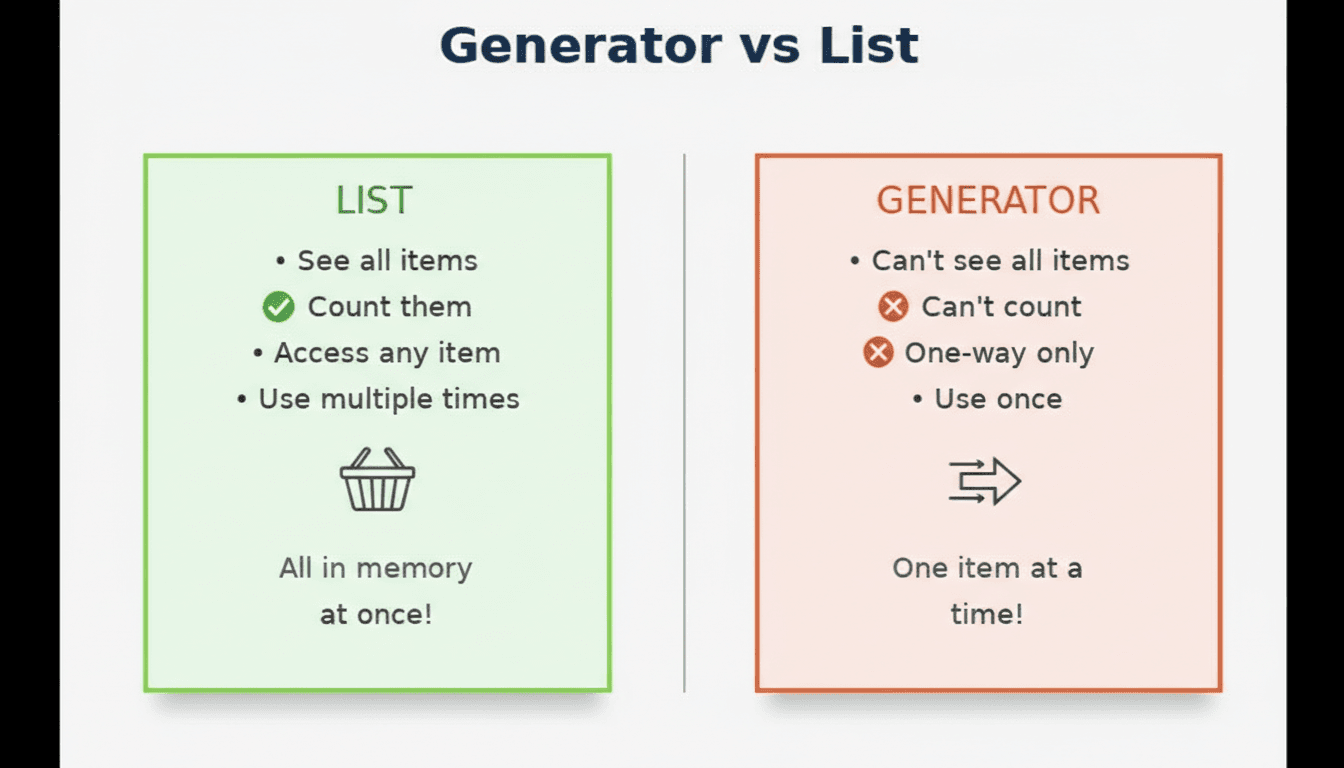
Generators vs Lists in Python: Which One Should You Use?
Introduction: The Memory Dilemma
You're processing a massive dataset—millions of records. Do you load everything into a list and risk running out of memory, or is there a smarter way? Enter generators, Python's secret weapon for handling large data efficiently.
In this guide, we'll compare generators and lists, explore when to use each, and show you how to write cleaner, more memory-efficient code.
The Short Answer
| Feature | Lists | Generators |
|---|---|---|
| Memory usage | High (stores all items) | Low (yields one at a time) |
| Speed | Faster for iteration | Slightly slower |
| Indexing | Yes (list[0]) |
No |
| Reusability | Reusable multiple times | Single-use (exhaustible) |
| Length | Known (len(list)) |
Unknown |
| Storage | All items in memory | Generates items on-the-fly |
What's a List?
A list stores all elements in memory at once:
# Creating a list of 10 million numbers
numbers_list = [x for x in range(10_000_000)]
# Memory: ~320 MB

# You can:
print(numbers_list[0])        # Access by index
print(len(numbers_list))       # Know the length
print(numbers_list[-1])        # Access from end
Pros:
-
Fast random access
-
Can be reused multiple times
-
Supports slicing, sorting, reversing
Cons:
-
Memory-hungry
-
Slow to create for large datasets
What's a Generator?
A generator yields items one at a time without storing them:
# Creating a generator of 10 million numbers
numbers_gen = (x for x in range(10_000_000))
# Memory: ~0 bytes (only stores the range object)

# You can:
print(next(numbers_gen))      # Get first item (0)
print(next(numbers_gen))      # Get next item (1)
# But cannot: numbers_gen[0]  # TypeError!

# You MUST iterate:
for num in numbers_gen:
    if num > 5:
        break
Pros:
-
Extremely memory-efficient
-
Lazy evaluation (compute only what you need)
-
Can represent infinite sequences
Cons:
-
Single-use only
-
No random access
-
Slightly slower for small datasets
Real-World Memory Comparison
Let's see the difference:
import sys

# List comprehension
list_comp = [x**2 for x in range(1000000)]
print(sys.getsizeof(list_comp))  # ~8 MB

# Generator expression
gen_exp = (x**2 for x in range(1000000))
print(sys.getsizeof(gen_exp))    # ~104 bytes!

# That's 80,000x smaller!
Creating Generators
1. Generator Expressions (One-liners)
# List comprehension vs generator expression
squares_list = [x**2 for x in range(10)]
squares_gen = (x**2 for x in range(10))

print(squares_list)  # [0, 1, 4, 9, 16, 25, 36, 49, 64, 81]
print(squares_gen)   # <generator object at 0x...>
2. Generator Functions with yield
def fibonacci(limit):
    a, b = 0, 1
    while a < limit:
        yield a
        a, b = b, a + b

# Use it
for num in fibonacci(1000):
    print(num)  # 0, 1, 1, 2, 3, 5, 8, 13, 21, 34, 55, 89, 144, 233, 377, 610, 987
3. Generator Methods
def counter():
    i = 0
    while True:
        received = yield i
        if received == 'reset':
            i = 0
        else:
            i += 1

gen = counter()
print(next(gen))        # 0
print(next(gen))        # 1
print(gen.send('reset')) # Resets to 0
print(next(gen))        # 0
When to Use Lists
Use lists when you:
-
Need random access (access by index)
-
Need to iterate multiple times
-
Need to know the length upfront
-
Have a small dataset that fits in memory
-
Need to modify, sort, or reverse the data
-
Need to use list methods like
.append(),.pop(),.insert()
# Good use case for lists
def get_top_users(users):
    sorted_users = sorted(users, key=lambda x: x['score'], reverse=True)
    return sorted_users[:10]  # Needs indexing and sorting

# Good use case for lists
user_logs = []
for entry in log_stream:
    if entry['error']:
        user_logs.append(entry)  # Need to store for later analysis
When to Use Generators
Use generators when you:
-
Process large files (logs, CSVs, images)
-
Read streaming data (API responses, database cursors)
-
Compute infinite sequences (Fibonacci, primes)
-
Have memory constraints (limited RAM)
-
Only need to iterate once
-
Want lazy evaluation (compute only what's needed)
# Good use case for generators
def read_large_file(file_path):
    with open(file_path) as f:
        for line in f:
            yield line.strip()

# Process line by line without loading entire file
for line in read_large_file('huge_file.txt'):
    process(line)  # Memory efficient!

# Infinite sequence
def infinite_evens():
    num = 0
    while True:
        yield num
        num += 2

evens = infinite_evens()
print(next(evens))  # 0
print(next(evens))  # 2
print(next(evens))  # 4
Performance Comparison
Let's benchmark:
import time
import sys

# Create list
start = time.time()
list_data = [x**2 for x in range(10_000_000)]
list_time = time.time() - start
list_mem = sys.getsizeof(list_data)

# Create generator
start = time.time()
gen_data = (x**2 for x in range(10_000_000))
gen_time = time.time() - start
gen_mem = sys.getsizeof(gen_data)

print(f"List: {list_time:.2f}s, {list_mem/1024/1024:.1f} MB")
print(f"Generator: {gen_time:.2f}s, {gen_mem} bytes")

# Iteration speed comparison
start = time.time()
for num in list_data[:1000000]:  # Only first million
    pass
list_iter_time = time.time() - start

start = time.time()
for num in (x**2 for x in range(1000000)):
    pass
gen_iter_time = time.time() - start

print(f"List iteration: {list_iter_time:.4f}s")
print(f"Generator iteration: {gen_iter_time:.4f}s")
Typical results:
-
List creation: 0.8s, 320 MB
-
Generator creation: 0.0s, 104 bytes
-
List iteration: 0.05s
-
Generator iteration: 0.07s (slightly slower)
Common Pitfalls
1. Exhausting a Generator
gen = (x for x in range(3))
print(list(gen))  # [0, 1, 2]
print(list(gen))  # []  # Generator is exhausted!
Solution: Recreate the generator if you need to iterate again.
2. Converting Generators to Lists (Defeats Purpose)
# DON'T DO THIS - loads everything into memory
gen = (x**2 for x in range(1000000))
listified = list(gen)  # Memory spike!

# DO THIS - process as needed
gen = (x**2 for x in range(1000000))
for num in gen:
    process(num)  # Memory efficient
3. Using len() on Generators
gen = (x for x in range(10))
print(len(gen))  # TypeError: object of type 'generator' has no len()
Solution: Track count manually or convert to list (if small enough).
Advanced Generator Patterns
1. Generator Pipelines
Chain generators together for data processing:
def read_data():
    for i in range(1000000):
        yield i

def filter_even(data):
    for num in data:
        if num % 2 == 0:
            yield num

def square(data):
    for num in data:
        yield num**2

# Pipeline - data flows through!
data = read_data()
filtered = filter_even(data)
squared = square(filtered)

for result in squared:
    if result > 100:
        break  # Stops processing all generators!
2. yield from for Delegation
def chain(*iterables):
    for iterable in iterables:
        yield from iterable  # Delegates to sub-iterators

for value in chain([1, 2], (3, 4), "56"):
    print(value)  # 1, 2, 3, 4, '5', '6'
3. Generators as Coroutines
def logger():
    while True:
        log_entry = yield
        timestamp = time.time()
        print(f"[{timestamp}] {log_entry}")

log = logger()
next(log)  # Initialize
log.send("Started processing")
log.send("Completed successfully")
Best Practices
-
Start with lists for small data, switch to generators when memory becomes an issue.
-
Profile before optimizing - don't prematurely optimize.
-
Use generator expressions instead of list comprehensions for large datasets.
-
Document generator behavior - especially if they're single-use.
-
Choose based on use case:
-
Multiple passes, random access, modification → Lists
-
Single pass, streaming, memory constraints → Generators
-
Quick Decision Guide
Need random access?
    YES → Use a list
    NO  → ↓

Need to iterate multiple times?
    YES → Use a list
    NO  → ↓

Is data size > 100k items?
    YES → Use a generator
    NO  → ↓

Need to know length?
    YES → Use a list
    NO  → ↓

Working with files/streams?
    YES → Use a generator
    NO  → Use a list (it's simpler)
Conclusion
Lists are your go-to for everyday tasks with small to medium datasets. They're familiar, fast, and flexible.
Generators shine when you're dealing with large data, streaming, or infinite sequences. They're your memory-saving superheroes.
The key is understanding the trade-offs and choosing the right tool for the job. As you gain experience, this decision becomes second nature.
Contact Us
Phone: +91 9667708830
Email: info@codingnow.in
Website: https://codingnow.in/
Address:
2nd Floor, Kapil Vihar (Opp. Metro Pillar No.354)
Pitampura, New Delhi – 110034
Backlink to main website: Explore Python and AI courses at Coding Now – Gurukul of AI
