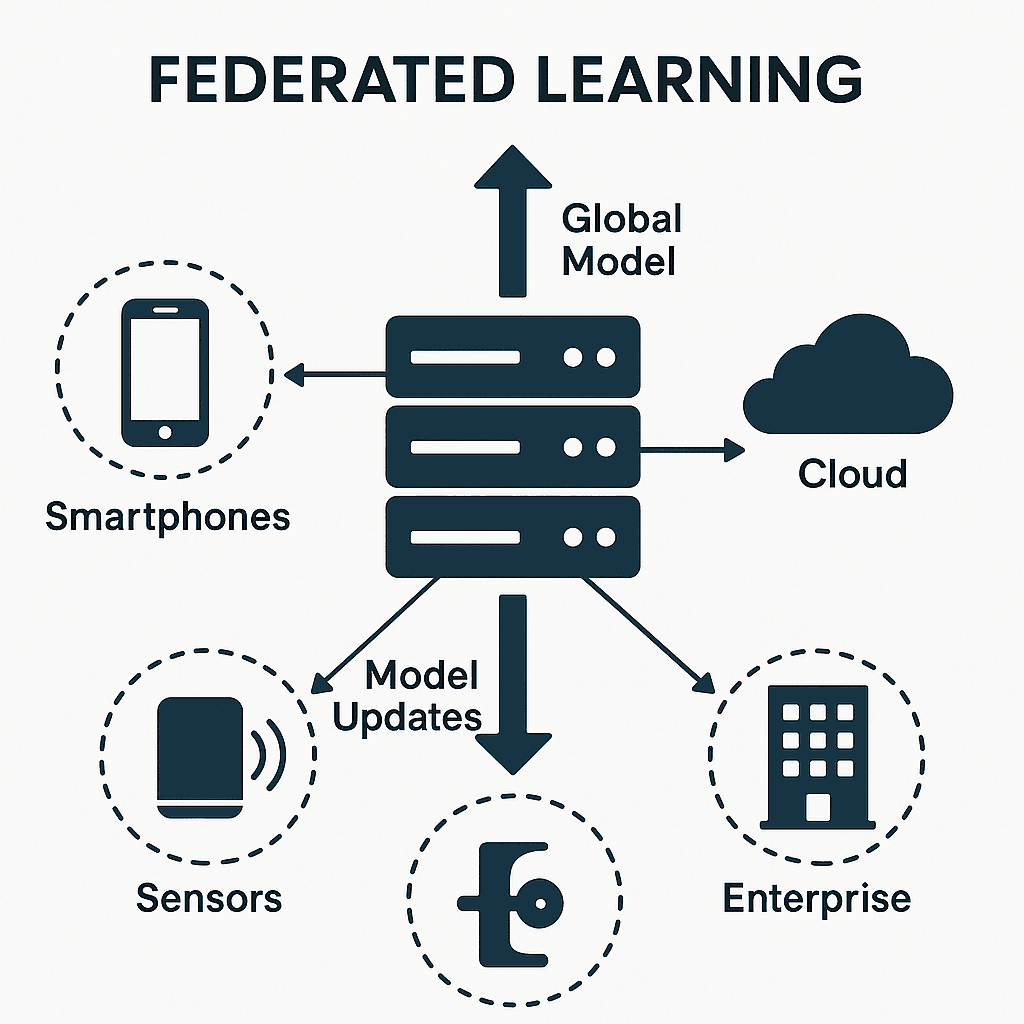
Federated Learning Explained: Training AI Without Sharing Your Data
Imagine this: Your smartphone learns to predict your next word without ever sending your private messages to the cloud. Hospitals collaborate to build a disease-detection AI without sharing patient records. Banks detect fraud together without exposing customer transactions.
Sounds impossible? It's not. It's called Federated Learning, and it's revolutionizing how we train artificial intelligence.
What is Federated Learning?
Federated Learning is a machine learning approach that trains models across multiple decentralized devices or servers holding local data samples, without exchanging those data samples.
In simple terms: The data never leaves your device. Only the learning travels.
Instead of collecting all data in one central server (traditional approach), federated learning brings the model to the data, not the data to the model.
How Does It Work?
Here's the step-by-step process:
-
Start with a global model – A base AI model is created and sent to all participating devices.
-
Local training – Each device trains the model using its own local data. This data never leaves the device.
-
Send updates, not data – Devices send back only the model updates (gradients or weights) to the central server—never the raw data.
-
Aggregate updates – The central server combines all the updates (using techniques like FedAvg – Federated Averaging) to improve the global model.
-
Repeat – The updated global model is sent back to devices, and the cycle continues.
![Federated Learning Process: Central Server ↔ Multiple Devices exchanging model updates, not raw data]
Key insight: The server learns from all devices collectively but never sees any individual device's data.
Why Federated Learning Matters
1. Privacy First
Data never leaves its source. This is huge for:
-
Healthcare records (HIPAA compliance)
-
Financial transactions
-
Personal communications
-
Any sensitive data
2. Reduced Data Transfer
Instead of sending massive datasets (gigabytes or terabytes), only small model updates (kilobytes) are transmitted.
3. Real-Time Learning
Models learn continuously from user interactions in real-time. Your keyboard gets smarter every day.
4. Regulatory Compliance
GDPR, CCPA, and other privacy laws become easier to comply with since data isn't centralized.
5. Access to More Data
Organizations can collaborate without sharing proprietary data. Competitors can build better models together while keeping secrets.
Types of Federated Learning
1. Horizontal Federated Learning
-
Same features, different samples
-
Example: Two hospitals have different patients but similar data fields (age, symptoms, diagnosis)
-
Most common scenario
2. Vertical Federated Learning
-
Same samples, different features
-
Example: Bank and e-commerce platform have same customers but different attributes (bank has credit history, e-commerce has purchase behavior)
-
More complex, requires entity alignment
3. Federated Transfer Learning
-
Different samples, different features
-
Use transfer learning to help each other when datasets don't overlap
-
Useful when participants have completely different data structures
Real-World Applications
Smartphone Keyboards (Gboard)
Google pioneered federated learning with Gboard. Your phone learns your typing patterns locally, improves next-word predictions, and sends encrypted updates—all without uploading your private conversations.
Healthcare
Hospitals across the world collaborate to train cancer detection models without sharing patient records. Each hospital trains locally on its data; only the learning is shared.
Finance
Multiple banks detect fraud together. Each bank has unique fraud patterns. Federated learning creates a robust global model without exposing customer transactions.
Manufacturing
Smart factories train predictive maintenance models. Each factory keeps its proprietary data while benefiting from collective learning.
Autonomous Vehicles
Cars learn from real-world driving experiences without uploading sensitive location data. Every car becomes smarter while protecting driver privacy.
Smart Home Devices
Voice assistants (Alexa, Siri) improve speech recognition based on your voice patterns—without sending your conversations to the cloud.
Technical Deep Dive
Federated Averaging (FedAvg)
The most popular aggregation algorithm:
-
Server initializes global model weights
-
Selects a fraction of devices (e.g., 10%)
-
Each selected device trains locally for several epochs
-
Devices send back updated weights
-
Server averages all weights:
w_new = average(w1, w2, ..., wn) -
Repeat
Challenges and Solutions
| Challenge | Solution |
|---|---|
| Communication overhead | Compression techniques, fewer rounds |
| Heterogeneous devices | Adaptive algorithms (FedProx, SCAFFOLD) |
| Unreliable devices | Dropout handling, asynchronous updates |
| Non-IID data | Personalized FL, clustered FL |
| Security | Secure aggregation, differential privacy |
| Scalability | Hierarchical FL (edge servers) |
Security and Privacy in Federated Learning
Federated Learning is private but not perfectly secure. Here's why:
Potential Attacks:
-
Gradient Inversion – Malicious server can reconstruct data from gradients
-
Membership Inference – Determine if specific data was used in training
-
Model Poisoning – Malicious devices send bad updates
Defenses:
-
Differential Privacy – Add noise to updates to prevent reconstruction
-
Secure Aggregation – Encrypt updates so server only sees the average
-
Homomorphic Encryption – Compute on encrypted data
-
Anomaly Detection – Filter out suspicious updates
-
Zero-Knowledge Proofs – Verify correctness without seeing data
Pro tip: Use differential privacy + secure aggregation for maximum protection.
Federated Learning vs. Traditional Approaches
| Aspect | Traditional ML | Federated Learning |
|---|---|---|
| Data location | Centralized | Decentralized |
| Privacy | Low (data shared) | High (data stays local) |
| Communication | Huge data transfer | Small model updates |
| Compute | Centralized powerful servers | Distributed edge devices |
| Real-time updates | Periodic batch | Continuous |
| Compliance | Harder (GDPR) | Easier |
| Trust | Central authority required | Trustless possible |
Popular Federated Learning Frameworks
| Framework | Maintained By | Key Features |
|---|---|---|
| TensorFlow Federated | Most popular, integrates with TF | |
| PySyft | OpenMined | Privacy-preserving, blockchain ready |
| FATE | WeBank | Industrial-grade, vertical FL |
| NVFlare | NVIDIA | Healthcare focus, GPU acceleration |
| FedML | FedML Inc | Cross-platform, MLOps support |
| FLOWER | Adap GmbH | Lightweight, framework-agnostic |
The Future of Federated Learning
Emerging Trends:
1. Personalized Federated Learning
Not one global model—personalized models for each user while benefiting from collective learning.
2. Blockchain + Federated Learning
Decentralized, transparent, and incentivized FL with smart contracts.
3. Federated Learning at the Edge
Processing on edge devices (IoT, smartphones, sensors) for ultra-low latency.
4. Vertical Federated Learning Growth
More cross-industry collaboration (e.g., insurance + healthcare).
5. Federated Reinforcement Learning
Training RL agents across environments without sharing state/action data.
6. Legal and Regulatory Frameworks
New laws specifically for collaborative AI without data sharing.
When to Use Federated Learning
Perfect Use Cases:
-
Sensitive data (healthcare, finance, legal)
-
Privacy regulations (GDPR, HIPAA)
-
Large distributed networks (smartphones, IoT)
-
Collaborative but competitive organizations
-
Need for continuous real-time learning
Not Suitable When:
-
You can easily centralize data
-
Devices have unreliable connectivity
-
Data distribution is extremely non-IID
-
You need feature-level insights from other parties
Getting Started: A Simple Code Snippet
Here's a glimpse using TensorFlow Federated:
import tensorflow as tf
import tensorflow_federated as tff

# Load your dataset
emnist_train, emnist_test = tff.simulation.datasets.emnist.load_data()

# Define a simple model
def create_keras_model():
    return tf.keras.Sequential([
        tf.keras.layers.Flatten(input_shape=(28, 28)),
        tf.keras.layers.Dense(128, activation='relu'),
        tf.keras.layers.Dense(10, activation='softmax')
    ])

# Wrap model for federated training
def model_fn():
    return tff.learning.from_keras_model(
        create_keras_model(),
        input_spec=emnist_train.element_spec,
        loss=tf.keras.losses.SparseCategoricalCrossentropy(),
        metrics=[tf.keras.metrics.SparseCategoricalAccuracy()]
    )

# Build federated averaging process
iterative_process = tff.learning.build_federated_averaging_process(model_fn)

# Initialize and train
state = iterative_process.initialize()
state, metrics = iterative_process.next(state, emnist_train.create_tf_dataset_for_client(client_id))

print(metrics)
Final Thought: AI That Respects Privacy
Federated Learning represents a paradigm shift in how we think about AI. It says: We don't need your data to learn from you. We need your wisdom, not your secrets.
It's the perfect balance between:
-
Power – Collective learning from global data
-
Privacy – Data never leaves its source
-
Collaboration – Organizations work together without exposing secrets
-
Compliance – GDPR and HIPAA become manageable
As AI becomes more pervasive, the question isn't just "What can AI do?" but "How can we trust AI?" Federated Learning answers that question by putting privacy first.
The future isn't about hoarding data. It's about sharing intelligence—without sharing
Contact Us
Phone: +91 9667708830
Email: info@codingnow.in
Website: https://codingnow.in/
Address:
2nd Floor, Kapil Vihar (Opp. Metro Pillar No.354)
Pitampura, New Delhi – 110034
Backlink to main website: Explore Python and AI courses at Coding Now – Gurukul of AI
